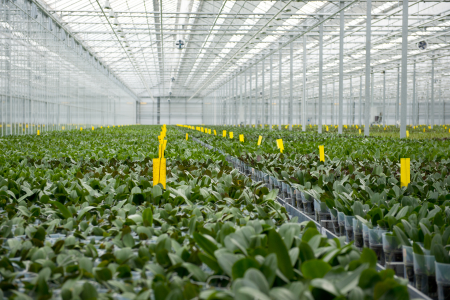
Controlled Environment Agriculture (CEA) is fundamentally reshaping the future of food production across East and Southeast Asia. Driven by climate volatility, rapid urbanisation and soil degradation, commercial producers are stepping away from traditional field agriculture.
Modern CEA facilities in Japan, South Korea and Taiwan are also establishing global benchmarks for automated, soil free cultivation. Simultaneously, fast scaling agricultural hubs in Vietnam, Thailand and Malaysia are adopting advanced hydroponics at scale. At the core of this regional transition is a shared technical operational mandate, transitioning from unmanaged soils to high purity, low salinity growing media.
The Tech Pioneers, Precision Substrates in Japan, South Korea, and Taiwan
In hightech markets like Japan, South Korea and Taiwan, commercial growers operate under tight land constraints and demanding consumer quality standards.
| The Asian CEA Substrate and Technology Spectrum | |
| Hightech Advanced Markets Japan, South Korea, Taiwan | Fast Scaling Agritech Hubs Vietnam, Thailand, Malaysia |
| Closed-loop glasshouse and plant factoriesPrecise root-zone fertigationLow EC (<0.5 mS/cm) requirementFocus: High value ornamentals, specialty berries, vine crops | High-altitude poly-tunnels and tabletop hydroponic systemsSoil-pathogen mitigation focusRapid transition to substrate grow bagsFocus: Strawberries, tomatoes, peppers, melons |
Growers in these regions rely heavily on automated drip fertigation systems that demand complete control over root zone chemistry. Standard field soil or unwashed media introduces variable salt levels and pathogen risks that disrupt precise nutrient formulas.
To achieve maximum yields per square metre, facilities across Taiwan, South Korea and Japan utilise triple washed, calcium buffered coco coir grow bags. Maintaining a consistently low Electrical Conductivity ($\text{EC} < 0.5 \text{ mS/cm}$) ensures that sensitive crop roots absorb critical nutrients such as calcium and nitrate, without facing osmotic stress or salt burn.
Scaling up the Hydroponic Shift in Vietnam, Thailand and Malaysia
In Southeast Asia’s primary agricultural centers, the adoption of high performance soilless media is expanding rapidly.
- Vietnam (Dalat Region): High altitude growers in Dalat are replacing traditional soil beds with elevated coir grow bags to cultivate bell peppers, tomatoes and cut flowers, eliminating recurring soil borne diseases like Fusarium and Pythium.
- Thailand: Modern commercial facilities focusing on melons, strawberries and high value table vegetables are moving away from raw, unwashed domestic husks in favour of horticultural grade, triple washed coir substrates.
- Malaysia (Cameron Highlands): Commercial strawberry and vine vegetable producers are transitioning en masse to tabletop hydroponic systems using 100% coir grow bags to optimize picking efficiency and boost crop turnaround times.
Why Substrate Quality Defines CEA Success
Across all six markets, commercial success in CEA comes down to three technical parameters in the root zone:
- Uncompromising Salinity Control ($\text{EC} < 0.5 \text{ mS/cm}$): Triple washing removes residual sodium ($Na^+$) and potassium ($K^+$) ions natural to coconut husks, providing an inert growing base.
- Optimal Air-Filled Porosity (AFP): Formulated chip-to-pith coir blends maintain a $20\text{–}25\%$ air-filled porosity, preventing root suffocation during frequent irrigation cycles.
- Buffer Balance: Calcium buffering stabilizes the cation exchange capacity (CEC), preventing the substrate from lock-outs that rob plants of essential nutrition.
As agricultural operators across Taiwan, Malaysia, Thailand, Vietnam, South Korea and Japan continue to modernise, standardised, high-purity coir substrates serve as the reliable foundation driving Asia’s modern farming revolution.
While high-tech Controlled Environment Agriculture (CEA) is rapidly accelerating across East Asia, the majority of farming across South Asia and Southeast Asia still relies on conventional agriculture (open-field soil cultivation). Smallholder farmers in regional agricultural belts across India, Indonesia, the Philippines, Myanmar and Cambodia continue to depend on traditional soil beds, seasonal weather cycles and open-air practices due to low capital entry barriers and established local farming infrastructure.
In these traditional soil systems, growers often utilise raw or unwashed coir dust purely as a cheap, localised soil amendment to increase moisture retention and organic matter, rather than deploying high-spec, low-EC substrates engineered for precision hydroponic closed loops.
As Asian agriculture pivots towards precision, high purity coir substrate remains the vital bridge between traditional soil farming and modern hydroponic systems. By guaranteeing low salinity, optimal aeration and pathogen free root zones, CoirRoots, Sri Lanka equips growers across East, Southeast and South Asia to eliminate soil risks and maximise total yield per square metre.