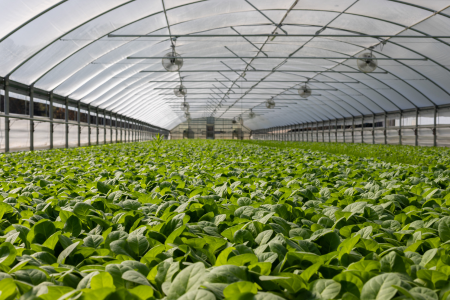
China leads global facility horticulture, operating thousands of hectares of hightech glasshouses, solar greenhouses and indoor vertical farms. As the country accelerates its transition from traditional soil farming to Controlled Environment Agriculture (CEA), substrate performance has become a major factor in farm profitability.
Among soilless media, imported coco coir has emerged as a top substrate. However, Chinese CEA operators increasingly realize that raw coir is not plug-and-play. High performing facilities now require Low Electrical Conductivity(EC) and triple washed coir.
Raw coconut husks naturally accumulate sodium ($Na^+$) and potassium ($K^+$) salts. Without thorough processing, these background salts create high Electrical Conductivity ($EC$), leading to osmotic stress, root tip burn and nutrient blockages. Triple washing and calcium buffering remove these unwanted ions, giving commercial growers full control over their fertigation recipes.
Understanding why low EC, triple washed substrates are essential requires looking at how they impact China’s primary modern agricultural sectors.
1. High Value Vine Crops in Major Agricultural Hubs
The largest agricultural regions in China, such as Shandong Province and Liaoning Province, host vast concentrations of multi-span glasshouses and commercial solar greenhouses. Operations in these provinces focus on long cycle, high yield vine crops:
- Cucumbers and Mini Cucumbers: These crops feature rapid growth cycles and high water uptake, requiring precise root-zone nutrition.
- Cherry and Truss Tomatoes: High margin specialty tomato varieties require precise calcium uptake to prevent blossom-end rot.
- Sweet and Hot Peppers: Colored blocky peppers remain in production for months, making them vulnerable to long term salt accumulation.
In these long season crops, high EC substrate causes salts to build up in hydroponic gutters over time. Triple washed coir provides an inert foundation, ensuring that automated drip fertigation delivers balanced ratios of calcium, magnesium and nitrogen directly to the root zone without background salinity interference.
2. Urban Vertical Agriculture Around Tier 1 Megacities
Hightech hydroponic facilities and multi story vertical farms are rapidly expanding around major tier 1 cities, including Beijing, Shanghai, Guangzhou and Shenzhen. Driven by demand for fresh, local and pesticide free produce, these facilities prioritize crop rotation speed and high yields per square metre.
- Pak Choi, Bok Choy and Chinese Cabbage: Native Asian greens grown in high density automated gutters.
- Hydroponic Lettuces & Spinach: Grown in clean, soil free environments to meet strict “ready to eat” retail specifications.
These leafy greens have short harvest windows (often 20 to 30 days) and delicate root systems. Young seedlings and plugs exposed to high salinity substrate suffer osmotic shock, leading to slow growth and poor crop uniformity. Low EC, triple washed coir ensures immediate seed germination and fast root establishment, keeping harvest schedules on track.
3. High Density Soft Fruit Parks in Yunnan Province
Strawberries and blueberries are seeing the highest growth rate in commercial investment across modern Chinese agricultural parks, particularly in Yunnan Province. The region’s climate makes it an ideal hub for high density, elevated tabletop berry farming.
- Substrate Strawberries: Cultivated in tabletop grow bags to prevent soil-borne pathogens like Pythium and reduce manual picking labor.
- Container Blueberries: Grown in high-density open-top planter bags using customized coir substrate blends.
Soft fruits are among the most salt sensitive crops in commercial agriculture. Blueberries require a low EC environment ($EC < 0.5 \text{ mS/cm}$) and an acidic root zone. High sodium levels in unbuffered coir displace the calcium needed for firm fruit, causing root tip burn, soft berries and reduced shelf life. Triple washed, buffered coir protects root systems and helps maximize fruit quality for premium retail markets.
The Operational Advantage for Chinese Facilities
For Chinese CEA operators, using low EC, triple washed coco coir is a core risk management strategy. Eliminating background salinity gives growers complete control over plant nutrition, reduces disease risks and supports maximum yields across every square metre of production space.